
Joseph Pilates’ method of body conditioning is known for its anatomical correctness and emphasis on proper alignment in movement. Coined “the art and science of Contrology”, Joseph himself further described the work as “rigorously scientific, in accord with the dictates of human anatomy and physiology”. But, inquiring minds want to know: How did he learn about anatomy and physiology? What methods and theories did he model his own after?
While we have access to first-hand information about the work he created as well as the resources he potentially had access to, unfortunately, we know very little about how exactly he accumulated the knowledge needed to evolve his work. Documentation is poor, legends there are many.
In an interview in 1964, he shared that the observation of natural movement in animals served as the inspiration to develop Contrology. “I would lie in the woods for hours,” he said, “hiding in the leaves, watching the animals move. How the mother taught the young. No human mother takes care like an animal. A fox, a lion makes the weak ones learn!”
He also talked about a discarded anatomy book he was given by the family physician: “I learned every page; every part of the body. I would move each part as I memorized. I learned control here – like Contrology.”
While it’s unknown what book he referred to, here is one that has an undeniable link to Joseph Pilates’ work:
The Handbook of Anatomy for Art Students
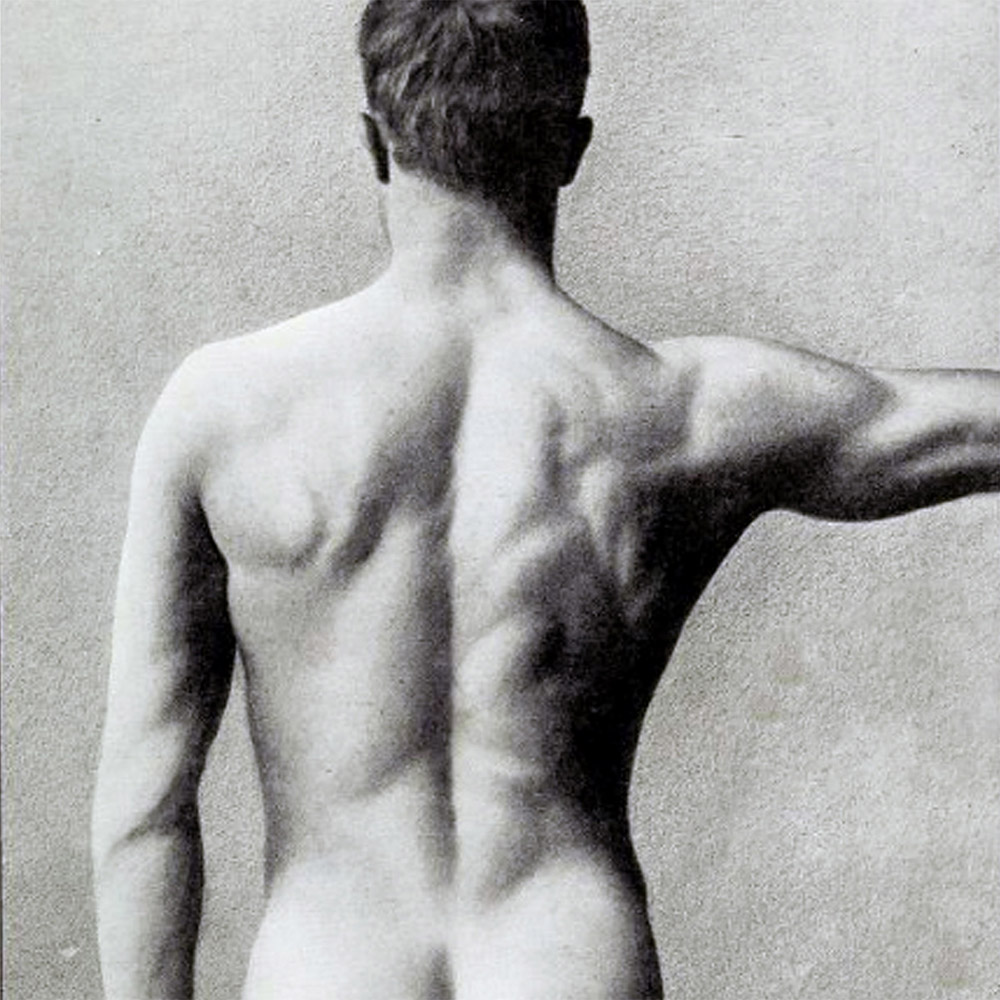
Written by Arthur Thomson and first published in 1896, this vintage guide for artists describes human anatomy, proportion, and movement in great detail, with a combination of drawings and photography in addition to the comprehensive text. It’s a fascinating read, especially in light of the possibility that this book may have inspired aspects of the Pilates method. For example, in comparing the spines of infants and adults, it illustrates how children have a spine straight as a plumb line —something Joseph Pilates frequently referred to in his writings.
Whether Joseph Pilates actually studied the book or not, we know that he had large prints of some of the book’s drawings on his studio walls. For the longest time, it was rumored that Joseph himself modeled for these drawings, yet both the time of the book’s publication and the photographs that stand alongside the drawings reveal otherwise (as you can see in some images from a first edition copy below).
If you want to study anatomy the way Joseph did, you’re in luck: the book is still in circulation through Dover Publications. While the information is clearly geared towards the art student rather than the movement teacher, the attention to detail and the description of movements, as well as their effect on the interior and exterior body, are simply wonderful.
Perhaps most importantly, the book invites a different perspective on how we can appreciate human anatomy and movement: as a work of art, indeed.


