
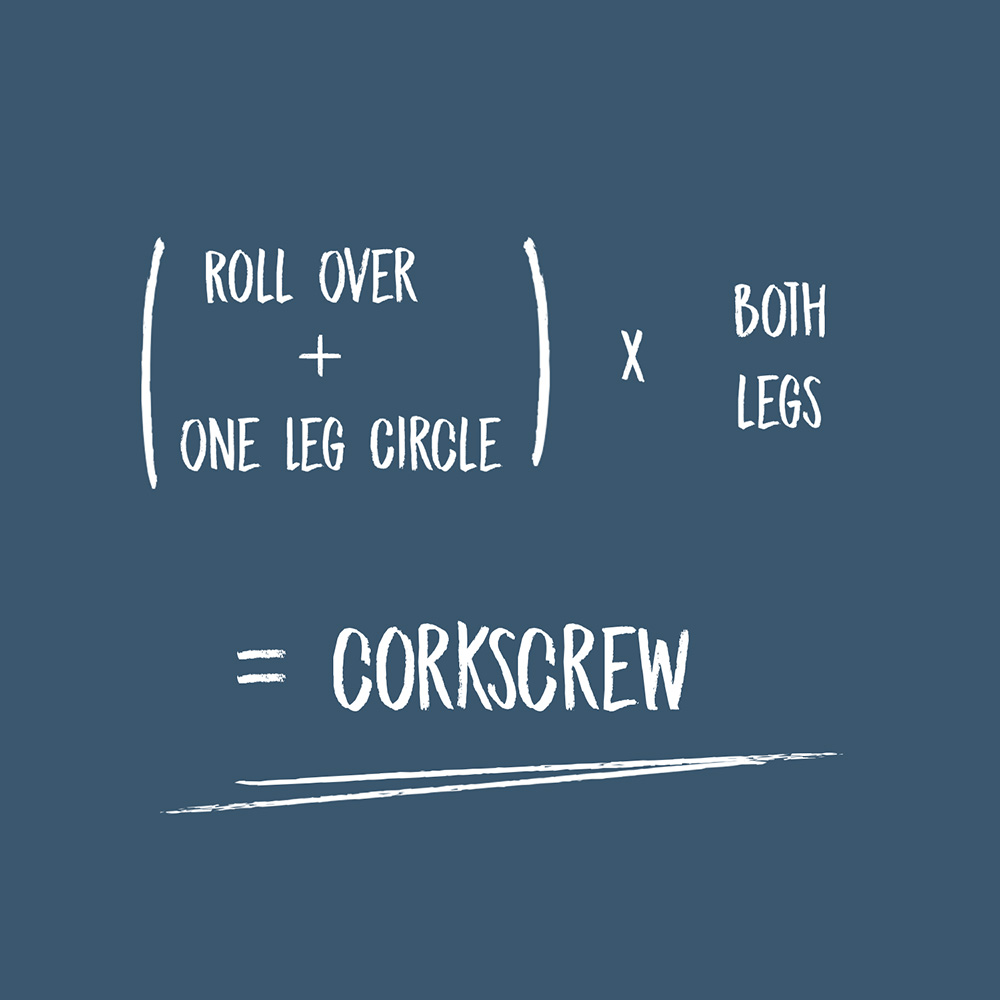
What do Pilates and mathematics have in common? According to Joseph Pilates the correct answer is: quite a bit!
In his essay “Contrology: practice and theory” from 1957, Joseph Pilates offers his most direct thoughts on how he felt his method needed to be taught and practiced. Throughout the essay (which can be read in its entirety in the Pilates Pamphlet), Joseph Pilates implies that the learning curve inherent to his work follows mathematic logic:
“Just as the embryo mathematician is first trained in the multiplication tables”, he writes, the Contrology student must first acquire a basic skill-set before learning “more difficult evolutions”. He further elaborates on the practitioner’s learning curve, which evolves from being instructed by the teacher to “disciplining oneself”, and “progressing imperceptibly from elementary to higher movements.”
The quotes above invite the hope that perhaps somewhere, Joseph Pilates created an abacus, or perhaps drew up a neatly configured table of movements that make navigating his vast method as easy as adding 2 and 2 together. Spoiler alert: he didn’t.
Yet, the Pilates method doesn’t merely appear systematic. Once the relationships between movements across the work are seen, understood, and applied, it becomes clear that the work was designed to follow a systematic logic.
In this system, Spine Stretch plus Rolling Back equals Rocker with Open Legs in the same way that 2 plus 2 equals 4.
Mathematic equations can only be fully solved when all the variables are known. The Pilates variables are the apparatus, the exercises, and the skillset of the moving body.
The fact that Joseph Pilates didn’t fully define his “multiplication tables” is not a deficit of the method. It might actually be its greatest asset, for it accommodates the most important and unknowable variable in the equation of any Pilates practice: the practitioner. The other variables of the original work—the exercises and the apparatus—can be readily understood and studied. It’s the biggest motivation behind showcasing the possible relationships between exercises throughout the method in our video catalog.
Often, these relationships are straightforward, such as practicing the same movement on a different apparatus with varied load volume, pull direction, surface, stability, etc. Other times, relationships are based on the common denominator between the two movements. For any movement requiring a grip on the handles, for example, a relationship can be drawn to the Hand Tensometer. For any movement involving a shoulder stand, there is a relationship to Reverse Push Through and other inversions, and so forth. And sometimes, the relationships may appear completely abstract, such as taking an element of a movement and building it up elsewhere within the method. Look long enough and you’ll discover the relationships.
In fact, you’ll find more as you go and will most definitely begin to come up with your own.
To sum it all up: the logic we are looking to uncover is an embodied logic. In order to understand the “multiplication tables” of Contrology, no variable may remain undiscovered, no stone left unturned. Rest assured that Joseph Pilates was well aware of the amount of work that went into understanding his method:
“Clearly, this scheme is for thinkers and doers.” ~ Joseph Pilates