The more I think about Pilates and the Pilates repertoire, the more I see how the work prepares someone for their life skills. But, it does so in pieces and absorbable systems; the exercises ensure that individual movement patterns can be successful before we integrate them into other things.
For example, the One Leg Circle is not something you see in your everyday life. I mean, when do you lay on your back and pick one leg up and circle it around?! But lying supine gives the body a ton of feedback; the gesturing leg can measure the range of motion of the hips, and the act of circling will determine if you have dynamic stability through the rest of your body. This gives way to other exercises, such as Shoulder Bridge, Leg Pull, and Control Balance. And those give way to other human experiences such as dancing, rock climbing, or karate.
Every new skill we learn as humans tends to have this pattern. Small and easy systems will create bigger skills. Here are some of my favorite examples of this design:
- learning ABC’s before reading chapter books
- ballet barre before dancing on stage
- playing scales on a piano before a recital
- addition before multiplication
Sometimes it is imperative to make sure every system is working well before it is executed. For example, if one light in the Christmas strand is out, the whole thing may not glow. You’ll have to individually check each bulb, find the burnt one, and change it. Then all lights are on—success!
When dealing with Pilates exercises this is often crucial in order to advance to the next level. Poor thoracic extension, for example, means the full Swan on the Cadillac may have to wait. First we work on the range of motion of the upper spine until there is the confidence that the exercise can be executed efficiently.
Is it always crucial to have every single system working perfectly before you move on? That depends. Let’s talk about your car: there are many sensors that light up to show that a specific system is not working properly. I would be more than happy and safe to drive my car if the windshield wiper fluid symbol is lit up. However, if the check engine light pops on, I will absolutely take my car to the shop. Systems are always important… but some more so than others.
A less-than-perfect Roll Up doesn’t mean other spinal articulation exercises, such as Teaser or Roll Over are off the table. Demanding perfection of one system before moving to another can quickly become frustrating. After all, this is a movement practice, and we need to MOVE!
So in conclusion: cultivating small systems really helps our life advance. It does not matter if you are talking about movement, technology, or learning a new skill. As movement practitioners, we need to decide if it’s imperative to work on a system now, or if it’s something that can be nurtured at a later time.
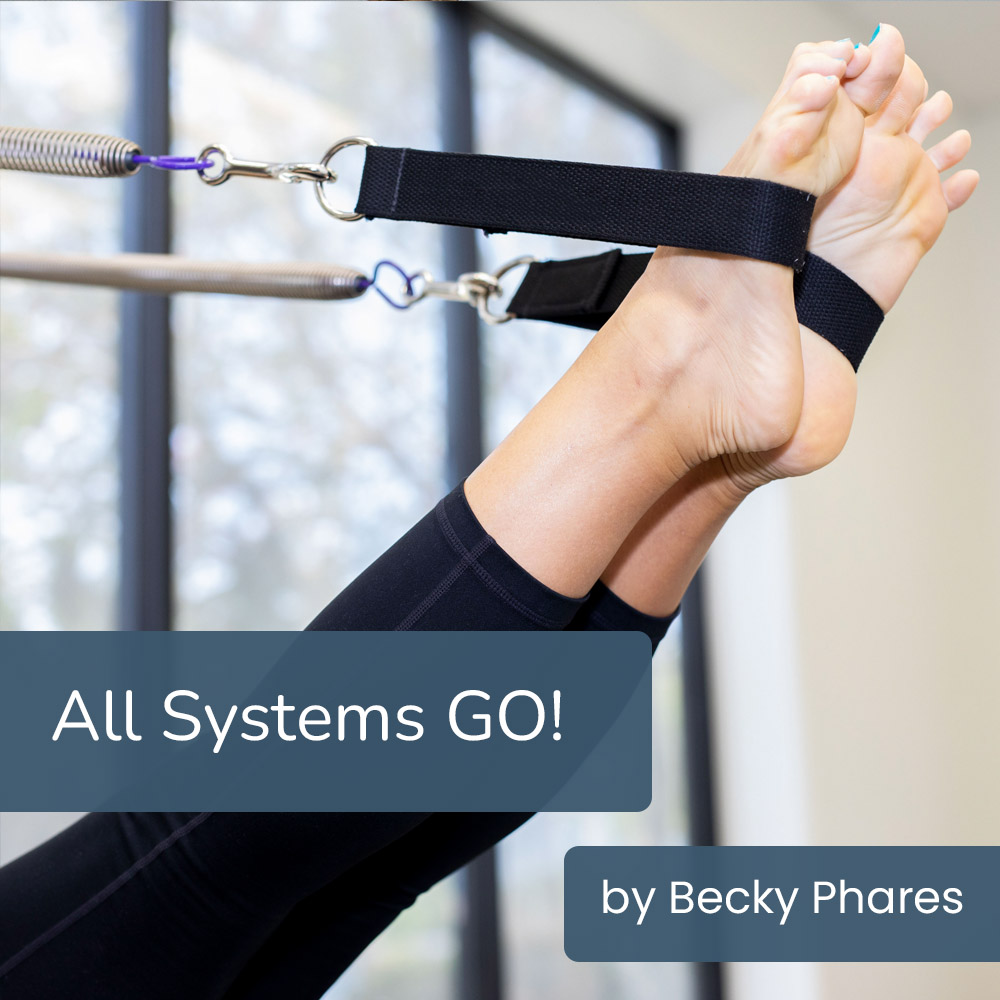
All systems GO!