
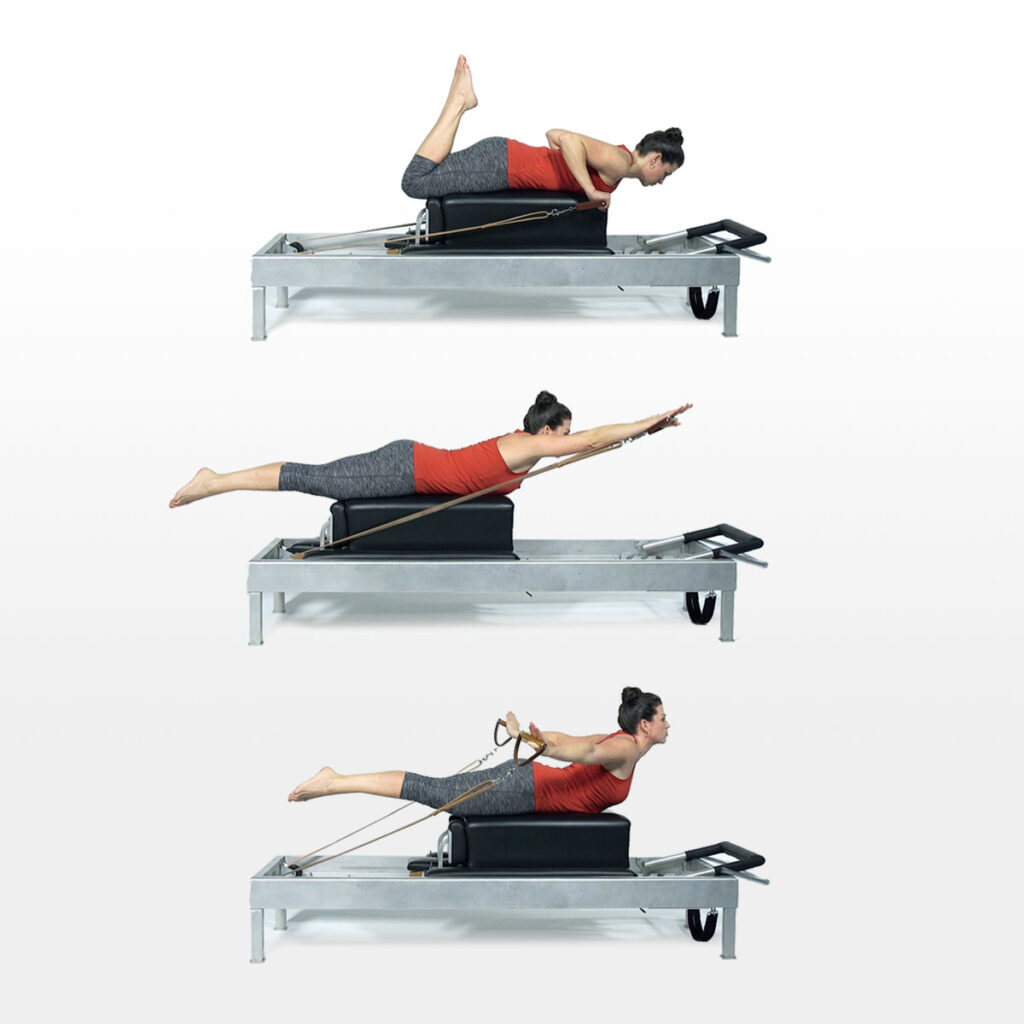
One of the most fascinating things about the Pilates method is that the longer you look, the more the systematic logic in the exercises reveals itself. And yet, there are those moments where you just have to wonder… HOW ON EARTH did [insert exercise name of your choosing] come about?
Case in point, our exercise of the month: Breaststroke on the Reformer. You don’t just accidentally stumble into an exercise that requires such a complex setup and choreography, even if you’re Joseph Pilates. This is the kind of exercise that is carefully constructed to meet a specific goal.
When we think of the Breaststroke, many of us will have the finished product in mind: a glorious backbend, seemingly in flight, with the Reformer straps and springs (and, if you’re lucky, a spotter!) putting the wind beneath your wings. But, the path to said finished product often feels less than airy… or even remotely airborne.
While it’s often considered an “advanced” or even “super-advanced” exercise, the inquisitive Pilates historian knows that originally, there was no such classification of the exercises; if the exercise was deemed part of the sequence, it’ll become part of your practice faster than you can say “Mönchengladbach”.
That’s not to say that the finished product is where we begin exploring the exercise, and the Breaststroke certainly doesn’t just appear out of thin air. But it’s also clear that if the original studio wasn’t a one-teacher-on-one-student business, then the chances that a spotter in shining armor would help you take off were fairly slim.
So, what are we looking at?
A kick to reset the body.
A stretch to engage the springs and dive into action.
A lift to propel the spine upwards.
A suspension to reap the rewards of the work and take in the view.
A kick, a stretch, a lift, a suspension. Simple enough, right?
Of course, there are some magic ingredients that make this movement more worthwhile. Perhaps the most important ones: synchronicity and timing. The arms and legs extend at the same time and before the backbend even begins. We love practicing this with the footbar first before working on the unassisted original using the straps. The spotter comes in eventually to take the deserving body to new heights… but not to do the work for you in the first place (though that’d be nice).
If you’re looking for other places to practice, you may have noticed an uncanny similarity in movement pattern with the Double Kick on the Mat, the Flying Eagle, and the Rocking. Chances are, that’s not just a happy coincidence. #itsallconnected
Members: let’s take this month and dedicate ourselves to this movement from the why to the how. Review the Breaststroke in our video catalog, check out our Learning Curve on Backbending, and most importantly: share with us in the Community area! Post a picture of your practice, ask a question, contribute answers, and share your top cues and tips.
Breaststroke – why exercise when you can fly?