
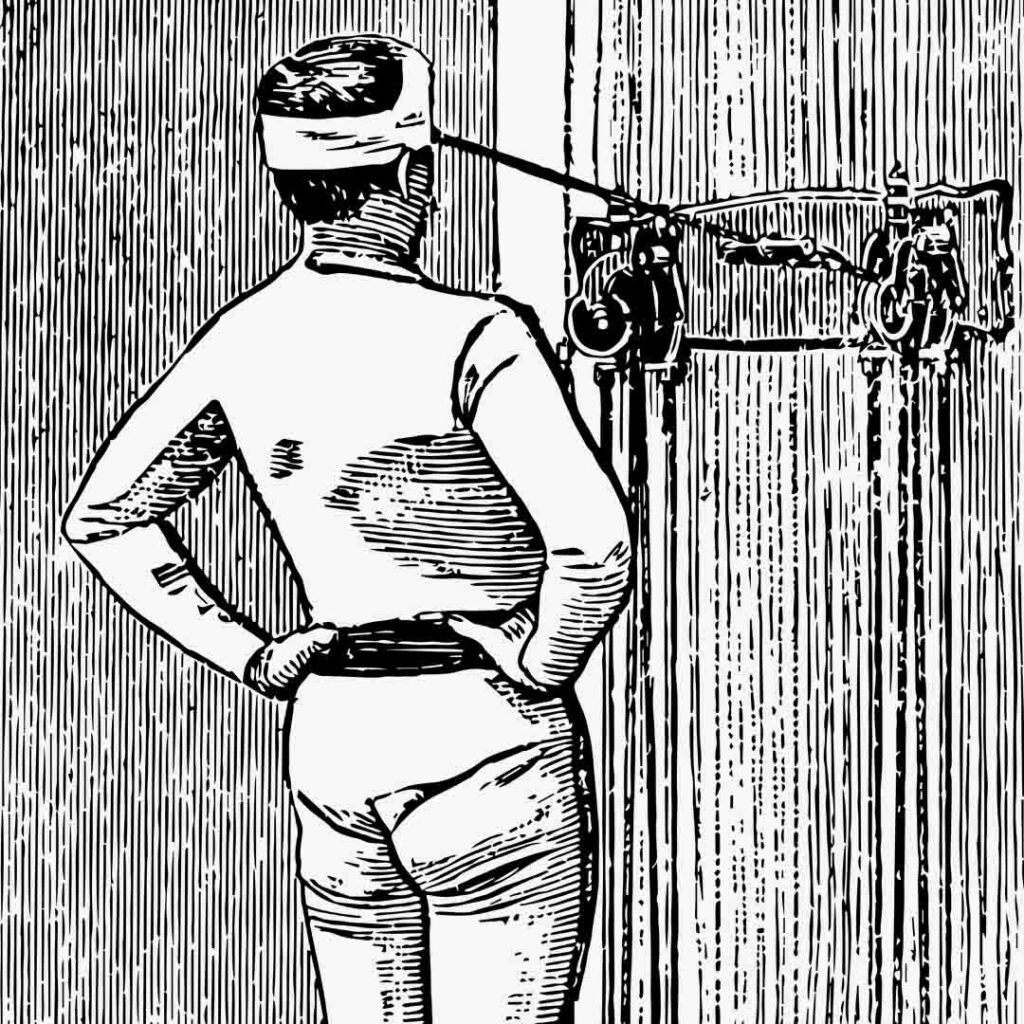
For every time you’ve asked yourself “how on earth did Joseph Pilates come up with this?” the answer may, at least in part include: he didn’t have to. From the use of springs in exercise equipment down to the specifics of certain exercises or pieces of apparatus, we typically can unearth an idea that has been around as long as the Pilates method, if not longer. Exhibit A: the Neck Stretcher!
When it comes down to the essence of Pilates apparatus, we talk about a means of resistance, attachment points, and specific movements associated with the use of the apparatus. And a lot of these—as outlandish as they may first seem compared to modern forms of exercise—they are pretty straightforward. If you want to train the musculature that keep your head aligned on top of your spine, then attaching a headband and providing resistance seems like a logical solution, doesn’t it?
As it turns out, not only Joseph Pilates thought so, as you can see in the two drawings of a similar approach to neck strengthening.
The Neck Stretcher a la Pilates additionally features a “magic square”, a metal framework that keeps the spring clear in its trajectory and allows for a very precise application of resistance. And the rest is Pilates as we know it, allowing you to perform familiar movements—the Roll Back, the Thigh Stretch, the Spine Stretch, to mention but a few—with the added support and resistance from this rather clever device.
Once again, Pilates proves to be a last-remaining window into the time of holistic physical culture, where not one body part was left unaddressed!